Summary
This giblet gravy recipe is intended for home cooks who want a classic, savory gravy to serve with roasted poultry in everyday meal settings.
Suitable For
- Home cooks preparing a roasted turkey or chicken for an everyday meal or gathering.
- People who want to use poultry giblets (neck, heart, gizzard, liver) in a straightforward, classic gravy.
- Cooks who prefer clear, step-by-step instructions with standard kitchen equipment and common ingredients.
Not Suitable For
- Individuals who avoid poultry by-products such as giblets for personal, cultural, or dietary reasons.
- People who need to follow ingredient restrictions that limit the use of flour, butter, or poultry stock.
- Cooks who do not have access to basic stovetop equipment (saucepan, knife, cutting board, whisk).
Main Content
Ingredients (Approx. 6–8 Servings)
- Giblets from 1 turkey or large chicken (neck, heart, gizzard, liver; liver set aside separately)
- 4 cups (about 1 liter) water or unsalted poultry stock, divided
- 2 tbsp unsalted butter (about 28 g)
- 3 tbsp all-purpose flour (about 24 g)
- 1 small onion, peeled and roughly chopped
- 1 small celery stalk, roughly chopped
- 1 small carrot, roughly chopped (optional)
- 1–2 bay leaves (optional)
- Salt to taste
- Ground black pepper to taste
- Optional: 1/2 to 1 cup (120–240 ml) pan drippings from roasted poultry, with excess fat skimmed
Equipment
- Medium saucepan (at least 2–3 quart / 2–3 liter size)
- Small skillet (for browning liver, optional)
- Cutting board and sharp knife
- Fine-mesh strainer or slotted spoon
- Whisk
- Measuring cups and spoons
- Heat-resistant spoon or spatula
Step 1: Simmer the Giblets for Broth
- Place the neck, heart, and gizzard into a medium saucepan. Set the liver aside in the refrigerator for later use.
- Add the chopped onion, celery, carrot (if using), bay leaves (if using), and 3 cups of water or unsalted poultry stock to the pan.
- Set the pan over medium-high heat and bring the mixture to a gentle boil.
- Once boiling, reduce the heat to low, cover the pan loosely with a lid, and simmer for about 45–60 minutes, until the giblets are firm and cooked through.
- During simmering, skim off any foam or particles that rise to the surface using a spoon, if desired.
Step 2: Strain and Chop the Giblets
- After simmering, turn off the heat. Use a slotted spoon to remove the giblets and set them on a cutting board to cool slightly.
- Pour the cooking liquid through a fine-mesh strainer into a heatproof bowl or measuring jug, discarding the vegetables and bay leaves. You should have about 2–3 cups of broth; if less, add water or stock to reach 3 cups.
- When the giblets are cool enough to handle, finely chop the neck meat (removed from the bones), heart, and gizzard into small, bite-size pieces.
- Discard the neck bones. Set the chopped giblets aside.
Step 3: Cook the Liver (Optional but Traditional)
- Place a small skillet over medium heat and add 1 teaspoon of butter or a small amount of cooking oil (taken from the listed butter or separately).
- Add the reserved liver and cook for about 2–3 minutes per side, until fully cooked through with no pink remaining inside.
- Transfer the cooked liver to the cutting board and finely chop it. Combine it with the other chopped giblets if you choose to include it.
- If you prefer a milder flavor, you may omit the liver from the gravy and set it aside for another use.
Step 4: Prepare the Roux Base
- In a clean medium saucepan, melt 2 tablespoons of butter over medium heat.
- When the butter is melted and begins to foam lightly, sprinkle in the 3 tablespoons of flour while whisking continuously.
- Cook the butter–flour mixture for about 2–3 minutes, whisking constantly, until it forms a smooth paste and takes on a light golden color. Avoid browning it too darkly if you want a lighter-colored gravy.
Step 5: Add Liquids and Thicken the Gravy
- Slowly pour about 1 cup of the warm giblet broth into the roux while whisking continuously to avoid lumps.
- Gradually add the remaining broth, whisking after each addition until the mixture is smooth.
- If using pan drippings, skim off most of the surface fat, then whisk 1/2 to 1 cup of drippings into the gravy base.
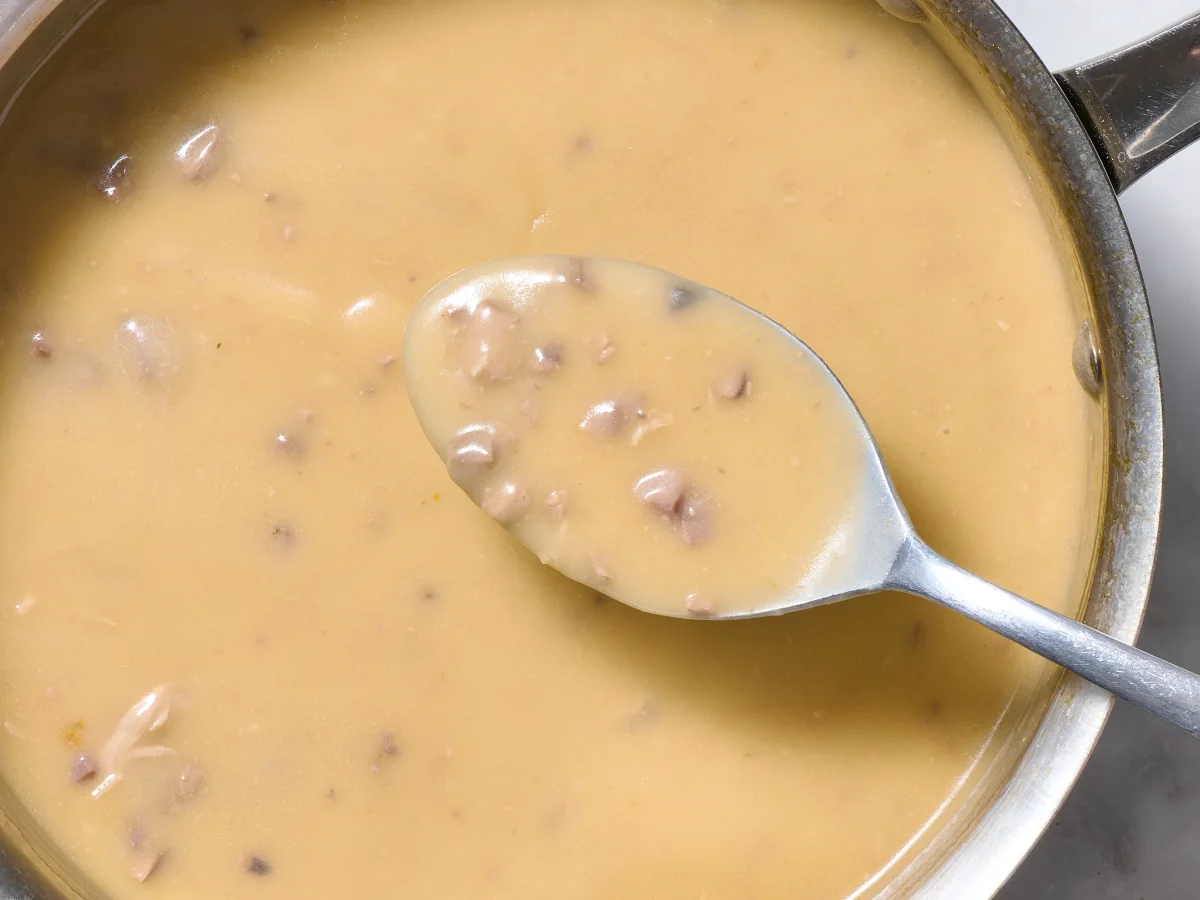
- Bring the mixture to a gentle simmer over medium heat. Cook for 5–10 minutes, whisking occasionally, until the gravy thickens to a pourable consistency that coats the back of a spoon.
Step 6: Finish, Season, and Serve
- Stir the chopped giblets (including liver if using) into the simmering gravy.
- Simmer for an additional 3–5 minutes, stirring occasionally, to evenly distribute the giblets and warm them through.
- Taste the gravy carefully and add salt and black pepper in small amounts, stirring and tasting after each addition until it matches your preferred seasoning level.
- If the gravy becomes thicker than desired, whisk in a small amount of hot water or stock, a few tablespoons at a time, until the consistency is suitable for pouring.
- Remove the pan from the heat. Transfer the gravy to a warmed gravy boat or serving bowl and serve with roasted poultry, mashed potatoes, or other side dishes as preferred.
FAQ
1. Is this giblet gravy suitable for everyday home meals?
This recipe is designed for everyday home cooking and can be used whenever you have poultry giblets on hand and want a classic gravy to accompany a meal.
2. Can I make this giblet gravy without liver?
Yes, you can omit the liver if you prefer a milder flavor or do not wish to use it. Simply leave it out and proceed with the neck, heart, and gizzard.
3. Can I replace the homemade giblet broth with ready-made stock?
You may use unsalted or low-salt poultry stock instead of water to simmer the giblets, or to supplement the liquid if you need more volume. Adjust salt at the end to match your taste.
4. Is it possible to make this gravy ahead of time?
You can prepare the gravy in advance, cool it to room temperature, store it in a covered container in the refrigerator, and reheat it gently on the stovetop, adding a small amount of stock or water if it thickens during storage.
5. What can I do if I need a smoother texture without giblet pieces?
If you prefer a smooth gravy, you can strain the finished gravy through a fine-mesh strainer to remove the chopped giblets, or blend the mixture carefully with an immersion blender until it reaches your desired texture.